I started this blog shortly after my initial dysautonomia diagnosis: POTS. My struggle with POTS was a big part of why I started this blog.
Please read my first post about my journey: My Struggle with POTS. I’m not going to go into as much detail here as I did in that post.
To learn more about POTS, please see my last Dysautonomia Awareness Month post: What is Dysautonomia. You can also watch this excellent video: What is POTS.
Summary of the First Part of my Journey
I first got sick around October 2014. It all started with a blood pressure check at a yearly checkup, where it was randomly 130/90 – for all my adult life I had been “normal” at 120/80. I was confused by the high reading, but felt okay… but that didn’t last long. My condition started to go downhill fast: dizziness, lightheaded-ness, feeling short on breath and tired easily, painful swelling in my extremities, more intense headaches more often, more intense temperature sensitivities, and a few other things that I didn’t think could be related or were related to conditions I already knew about. In general, I felt atrocious. I got really sick one night and went to get a blood pressure check at Walgreen’s, and it was 156/110! Not good.

It got to a point where I literally could not stand upright on my own. When Dan was at work, I was crawling around my house so that I wouldn’t fall (he was sweet enough to setup my coffee table with my most commonly used items every morning so I wouldn’t need to get up). When Dan was home, he was my “walker” and he would have to walk me everywhere. Otherwise, I was flat on my back on the couch.
My routine checkup with my rheumatologist (for my fibromyalgia) came about shortly after everything went haywire, and I mentioned the weird symptoms. He suggested I look into POTS. So I researched it, went to my PCP (well, a doc in the same clinic) and was prescribed a blood pressure medication and sent for testing.
Eventually, I had my tilt table test February 13, 2015. A tilt table test measures your heart rate and blood pressure in a lying down position, and then monitors you while you’re upright (they strap you to a table and tilt the table up). I saw the cardiologist April 8, 2015, and got my diagnosis of POTS.
Even though I had POTS, it wasn’t the “classic” form of the condition. In the “classic” POTS (the most common form), you stand up, your blood pressure plummets as your heart rate rises, and you either come close to passing out or pass out (depending on how low the blood pressure goes and how high the heart rate). When I was upright, my blood pressure and heart rate both skyrocketed and stayed there. (They also gave me half of a nitroglycerin tablet in the hopes of causing me to faint, but I never did. All the nitro did was make me super ill feeling, shoot my heart rate over 160 beats per minute, and make me wish I would pass out so it could be over with. I found out later that the nitro doesn’t actually do anything clinically and is more of a “torture device” for curiosity. Ugh.)
I was lucky. My diagnosis came just six months after the onset of my symptoms. A lot of people with POTS and dysautonomia have to wait six or more years to get a diagnosis! If my rheumatologist hadn’t been so knowledgeable, I would probably still be searching for an answer.
Living with POTS
I continued to see that cardiologist for a lot longer than I should have. The appointments bothered me, but I liked the rest of the staff and my doctor seemed to know about POTS. However, I was definitely doing most of the work myself – research, lifestyle changes, etc – and just getting prescriptions from my doctor.
 For medications, I was put on a cocktail of Corlanor, Bystolic, and losartan.* The losartan was the original medication my PCP put me on to lower my blood pressure; the Bystolic is a beta-blocker to help lower my blood pressure more, hold it steady, and lower my heart rate a bit (and I was put on a very low dose); the Corlanor was a fight with my insurance, but it was to lower my heart rate.
*I am not a doctor! I include these here just so my journey is more complete! Never ever ever make changes to your medications without talking to a doctor that knows your medical history! And please, don’t ever change heart medications without the thorough and watchful eye of a knowledgeable doctor!
Tools that I eventually found helpful were compression socks – I use knee highs and get a lot of the from RejuvaHealth because they have medical grade compression in cute patterns, I do not have an affiliation with them – that I would wear if I was going to need to be standing for a long period of time, increasing my salt when I felt symptomatic, and trying to rest as much as possible.
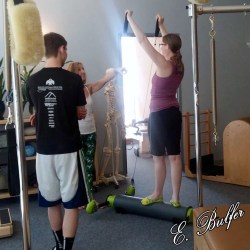
I had also, conveniently, started going to a wonderful Pilates and physical therapy studio for an unrelated problem! The studio is not covered by my insurance, but I had been recommended there after I almost ran out of insurance physical therapy. I’m so glad I went! Doing Pilates regularly – strengthening my core and legs – has proved invaluable to my dysautonomia journey! I have been having weekly physical therapy sessions, and attending regular Pilates classes, since early 2015 and it has helped me dramatically in my everyday functionality. While “have you tried Pilates?” is a horrible cliche question that many dysautonomia people face, it has honestly been one of the most helpful things in my search for wellness. I’ll write more about it later this month. But I do have to say, my early diagnosis and the fact that I started Pilates very early into the course of my condition have been essential to my progress and success at using it as treatment. Had I been dealing with this condition for even a year before trying Pilates, I doubt I’d have seen the benefits I have gotten.
As my relationship with my cardiologist continued, and I got increasingly annoyed, I began to wonder if I could be getting better guidance elsewhere. Then, at one visit, I mentioned that my toes were often so painfully cold I had to put heating pads on them to get relief – and I summed it up to my circulation. He said it wasn’t my circulation, it was because “you’re a woman.” Yes, he actually said that. Apparently, “all women complain about cold toes” was the reason my circulation was “just fine.” Dan and I were completely dumbfounded. I was supposed to schedule another appointment, but instead I just walked right past the scheduler desk and straight out of the office.
Newest Chapter in my Journey
A good friend, Nikki from Undiagnosed Warrior, recommended I go to see her cardiologist up at National Jewish Hospital. He had been instrumental in her diagnosis journey, so I decided to go for it.
My first visit with him was amazing! You can read more about it here: New Cardiologist Appointment. Unfortunately, he was moving to Kaiser which is the one place I couldn’t follow him. (In case you’re not in the USA, Kaiser is a medical system that is only available to people with their insurance. If you don’t have Kaiser, you cannot be seen in any of their facilities. If you do have Kaiser, literally all other facilities are “out of network.” In theory, it’s a great idea because you have integrated healthcare. In practice, everyone that I know with Kaiser and complex health has found it to be an absolute nightmare. Apparently, if you’re healthy, it is great, but only if you are a “normal” and healthy person.)
On my first – and only – visit with the new cardiologist, he told me “I don’t think you have POTS.” Oh. Okay then. That visit was February 8, 2017. That means I had the wrong diagnosis for almost two years!
Well, I don’t think it was necessarily the wrong diagnosis, but it no longer was true. I had been off Corlanor for quite some time, had been off losartan even longer, and was now taking just the Bystolic. I was still having horrendous dizziness, which I attributed to the Bystolic, and general feelings of “yuck,” but my heart rate seemed to be controlled pretty well.
In fact, there have been very few exceptions where my heart rate has gone over 120 beats per minute with normal activity. Yes, if I exert myself it’ll go higher and much easier than a “normal” person, but it only is POTS-like when I have a cold.
When I told the new doctor about the dizziness, and thinking it was related to the Bystolic, he reluctantly changed me over to another beta-blocker. I’m so glad I changed medications! The dizziness went away in two days, TWO DAYS, after stopping the Bystolic! I was still having problems with my blood pressure, however, because I was started on an incredibly low dose of the new medication: carvedilol.
I made an appointment to be seen by one of the cardiologists that would be taking over for new-cardio-1 (NC1) for the follow-up. He was also extremely thorough and listened really well. He agreed with NC1: I do not have POTS, but instead have an unknown type of dysautonomia and definite orthostatic intolerance. (Orthostatic intolerance is technically a “type,” but is mostly just the medical term for a symptom: the inability to tolerate being vertical.) This new cardiologist, Dr W, decided to test me for two other rare conditions that could cause my symptoms (don’t Google things if you really don’t want to know, because it turned out both of those conditions were likely fatal). Thankfully, those two rare conditions came back as negative!
On my third visit to Dr W (the second one was technically with the nurse practitioner and not him), I asked for him to increase the carvedilol. He did, and increased the dose from one tiny pill twice a day to two tiny pills twice a day (they really are the world’s smallest pills). By leaving it such that I’m taking four pills instead of two pills, he left me with the flexibility to change my dose two three pills if necessary. One of the problems I would have with the Bystolic was that I would get extremely low blood pressure at night and feel very sick. Thankfully, with my current carvedilol setup, if this starts to happen again I can change to two pills in the morning and one pill at night.
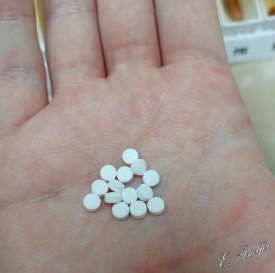
Carvedilol = some of the smallest pills you will ever encounter
This four pill dose seems to be helping a lot and my dizziness is not a factor! I have had very few instances of my blood pressure getting too high, and haven’t had my blood pressure get extremely low either. Honestly, I think it is why this summer and fall have been going so well for me!
“Part 2” will be coming next! Part two will talk more about the symptoms I experience daily and what life is like for me on a regular basis.
Please share this post to help spread awareness for dysautonomia and what it’s like to live with it! No one should have to wait six years for a diagnosis!
If you can afford even a small amount, please donate to Dysautonomia International: here. DI is funding crucial research into dysautonomia, and someday we will find a cure! Let’s make that cure happen faster!
Donate Now!



 In NCS, the person with the condition stands, experiences bradycardia and/or hypotension, then either experiences pre-syncope or full syncope. Pre-syncope is similar to the type of lightheaded-ness you experience if you stand up way to fast – except people with dysautonomia usually pass out if they do not sit or lay down quickly upon experiencing it. The hypotension is usually caused by blood pooling in the extremities – usually the legs and feet – and not circulating back up to the heart and brain.
 MSA occurs in adults age 40 and over, and kills the majority of those with the condition within 5-10 years of diagnosis. Almost everyone with the condition will be bedridden within two years of diagnosis.
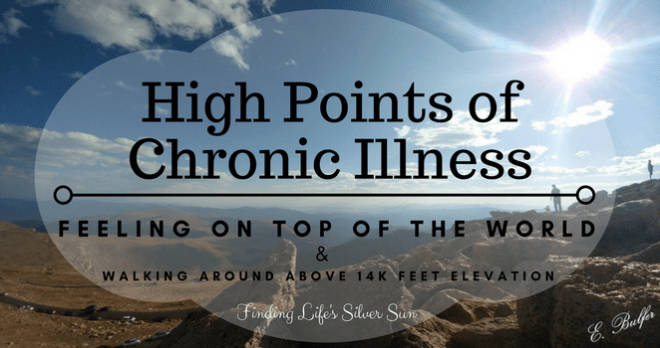
 However, I have been quite lucky lately: my body is cooperating. For the most part, I’ve been able to feel relatively normal in the past few weeks. No, I’m not ‘better’ but I’ve been able to do more than I had been able to do in over a year! My Pilates classes went surprisingly well, my physical therapy was going really well, and I’ve been able to be significantly more active day-to-day! Of course, I’m waiting to accidentally run off a cliff (metaphorically of course), but until then I’m really excited that my body is letting me be ‘normal’ most of the time!
 Most people with fibromyalgia agree that it storms into your life like a hurricane, knocks you flat on your back, and takes up residence in your life like an uninvited house guest that just doesn’t take a hint!
 For me, summer equals significantly more physical activity. I’m sure most people that live in an area that experiences winter will agree: when the weather is “nice” we do as much as possible to try to make up for being inside all winter. When you are chronically ill, however, more physical activity can also equal significantly more pain.



 Finding Life's Silver Sun